Contributor: Warren Ondanje, editorial direction and review
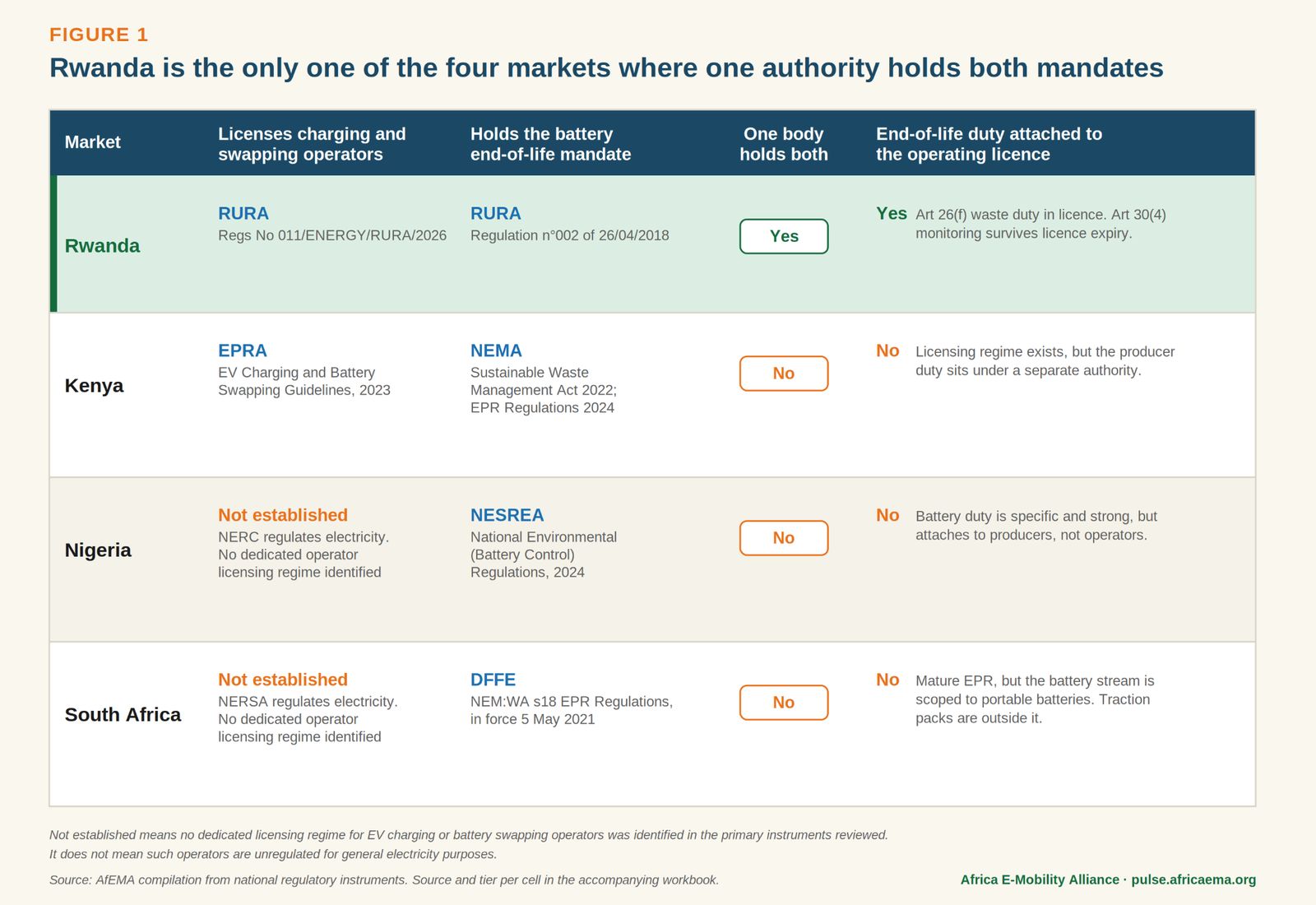
- Rwanda’s new charging and swapping regulation puts end-of-life duties on licence holders and keeps RURA monitoring them after the licence expires.
- The clause was available because RURA is both Rwanda’s utilities regulator and the body that issued its 2018 e-waste regulation.
- Kenya already routes charging licence applicants through NEMA, but that route focuses on environmental impact at development, not end-of-life.
- The lesson for peers is institutional. Regulators without both mandates cannot copy the clause, but can build the route there.
What Rwanda actually did
Regulations No 011/Energy/RURA/2026, governing electric vehicle charging infrastructure and battery swapping stations. Issued 29 June 2026 by the Rwanda Utilities Regulatory Authority.
Article 22 carries the interoperability obligation. The end-of-life duties sit in Article 26, among the quality of service conditions attached to the licence.
Rwanda now requires a licence to operate a public charging station, a public charging point on private property, or a battery-swapping charging station. Attached to that licence, among the service conditions, is an obligation to manage, store, transport and dispose of defective batteries and related e-waste in accordance with applicable environmental laws and approved hazardous waste standards. Licensees must replace defective batteries immediately and must not release them back into the supply chain. RURA’s power to monitor compliance with waste management and decommissioning terms continues after the licence term has ended.
Note what Article 26(f) does not do. It sets no disposal standard of its own and points to environmental law to make compliance a condition of holding the licence.
Why the handle was available
That handle exists because the same authority wrote both instruments. RURA is Rwanda’s utilities regulator and also the body that issued the country’s e-waste regulation in 2018, which remains in force unamended. A regulator drafting licence conditions against its own environmental instrument is doing internal work. A regulator drafting them against another agency’s statute is doing diplomacy.
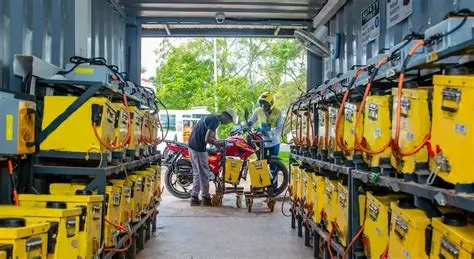
Of the four markets, Rwanda is the only one where the licensor and the end-of-life authority are the same body, and the table shows why.
Kenya is closer than it looks. EPRA requires an electricity retail supply licence before a public charging station can be installed, under powers in the Energy Act 2019. Its application requirements state that, unless the Authority expressly exempts it in consultation with NEMA, an applicant must hold a valid environmental impact assessment licence from NEMA specifically authorising development of the station. So a route between the energy regulator and the environmental authority already runs, and EPRA already exercises discretion in consultation with NEMA. What crosses that route is a development condition, not an end-of-life duty. Kenya does not need to invent an interagency mechanism. It needs to add a condition to one it already operates.
Nigeria has the more battery-specific instrument but without the enforcement component. The National Environmental (Battery Control) Regulations 2024 impose producer responsibility across the battery lifecycle under NESREA. But the duty attaches to importers, manufacturers and distributors, and neither NERC nor NADDC operates a distinct licence category for charging or swapping operators. The Electricity Act 2023 devolves intra-state electricity activity to state regulators, so any operator licence that did emerge would be at the sub-national level.
South Africa is the instructive one, because maturity in producer responsibility has not produced coverage. Its section 18 EPR regime has been in force since May 2021, but the battery stream covers portable batteries, and traction packs sit outside it. Charging operators are not licensed at all: reselling electricity falls under the Schedule 2 exemption to the Electricity Regulation Act, which requires registration with NERSA.
What it does not do
The 2018 e-waste regulation Article 26(f) points at covers waste electrical and electronic equipment, components and accumulators broadly, and does not expressly name traction batteries or EV battery systems. The licence condition therefore inherits whatever ambiguity sits in the instrument it refers to.
The enforcement is also thinner than the drafting suggests. The scheduled administrative fines attach to licensing faults: operating without a licence, unapproved expansion, relocation, cessation without notice. A breach of the waste conditions or the service standards carries no scheduled penalty and instead runs through the general enforcement ladder, ending in suspension or revocation. That is real power, but it is blunt and blunt powers get used late.
And the instrument creates no disposal capacity. Rwanda has an obligation and, as yet, no domestic hydrometallurgical processing to discharge it into.
Read against the AfEMA Implementation Index
The regulation touches on Theme 02: Charging and Swapping Infrastructure (high tier), Theme 05: Policy and Regulatory Framework, and Theme 06: Innovation and Ecosystem Development, where end-of-life sits.
It should not be expected to move Rwanda’s score. Pulse measures implementation rather than readiness, and an instrument issued two months ago has not yet been implemented by anyone. What would move a score is evidence on the ground: a first licensing round completed, inspection findings published, an enforcement action taken. Regulators are frequently surprised by this distinction, which is precisely why the Index is built the way it is.
Kenya’s is an interesting Index question. Adding a single condition to an existing licence, using an interagency route that already works, is potentially faster than what Nigeria or South Africa would need.
What to watch
- Whether the Rwanda Standards Board publishes the interoperability specification before the Article 22 transitional window closes in June 2028.
- Whether RURA brings a first enforcement action under Article 29 on a waste management or service standard breach, as distinct from a licensing fault.
- Whether EPRA adds an end-of-life condition to the retail supply licence, or how the current guidelines evolve into regulation.
- Whether the UIN standard for battery traceability, which Kenya’s Guidelines leave to be approved by the relevant authorities, is actually approved.
Sources
- RURA (2026). Regulations No 011/Energy/RURA/2026 of 29/06/2026 Governing Electric Vehicle Charging Infrastructure and Battery Swapping Stations, Articles 4, 6, 14, 18, 22, 26, 29, 30(4), 36. [Regulation]. rura.rw
- RURA (2018). Regulation n°002 of 26/04/2018 Governing E-Waste Management in Rwanda. [Regulation]. rwandatrade.rw
- EPRA (2023). Electric Vehicle (EV) Charging and Battery Swapping Infrastructure Guidelines, 2023, clauses 1.1 and 3.4 to 3.7 and Annex 1 (EPRA/ERE/ERE-2.02) item 7. Effective 1 September 2023. [Guidelines, made under the Energy Act, 2019]. epra.go.ke
- NESREA (2024). National Environmental (Battery Control) Regulations, 2024. [Regulation]. nesrea.gov.ng
- Federal Republic of Nigeria (2023). Electricity Act, 2023. [Act].
- DFFE (2020, in force 5 May 2021). Extended Producer Responsibility Regulations under section 18, National Environmental Management: Waste Act, GN 239, GG 44295. [Regulations]. dffe.gov.za
- Republic of South Africa (2006). Electricity Regulation Act No. 4 of 2006, Schedule 2. [Act]. gov.za
- NERSA (2021). Registration Procedure in terms of Schedule 2 of the Electricity Regulation Act, 2006. [Procedure]. nersa.org.za