Kenya’s National E-Mobility Policy has arrived at a time when electric medium- and heavy-duty vehicle technology is already mature and commercially viable, giving fleets real, deployable options today, not in the distant future. Large-scale deployment of EV technology across freight and passenger transport is both technically and strategically viable.
Policy Direction: Electrifying All Transport Segments
Kenya’s National E-Mobility Policy provides the country’s first coordinated framework for transitioning road transport from fossil fuels to electricity. Crucially, the policy encompasses medium- and heavy-duty vehicles (MHDVs), including buses and trucks, which recognise their disproportionate contribution to fuel use, operating costs, and emissions.
The policy aligns with international ambition under both the Global Memorandum of Understanding (MOU) on Zero-Emission Medium- and Heavy-Duty Vehicles and the broader Zero-Emission Vehicle (ZEV) Declaration, which commit signatories to accelerating the transition to zero-emission transport. Under the Global MOU, participating governments commit to:
- 30% zero-emission vehicle sales by 2030
- 100% zero-emission new truck and bus sales by 2040
The ZEV Declaration further reinforces the global shift toward phasing out internal combustion engine vehicle sales in leading markets. Together, these frameworks signal a clear international direction of travel: zero-emission transport is becoming the default pathway for future mobility systems.
Kenya’s national e-mobility policy lays the institutional, regulatory, and infrastructure groundwork needed to support this trajectory.
Medium- and heavy-duty vehicles (MHDVs) make up only about 4% of the global vehicle fleet, yet they account for roughly 36% of on-road fuel consumption and transport-related CO₂ emissions. Diesel vehicles generate 73 percent of on-road nitrogen oxides (NOₓ) and 60 percent of particulate matter, causing over 330,000 premature deaths annually and more than $1 trillion in yearly health damages. Electrifying this segment, therefore, delivers disproportionate climate, air quality, and fuel import reduction benefits compared to smaller vehicle categories.
Private Sector Momentum Is Already Underway
Vehicle registration data shows that electric mobility uptake in Kenya is accelerating, with early adoption now extending beyond two- and three-wheelers into larger commercial vehicle categories. While medium- and heavy-duty EV volumes remain small compared to the national vehicle fleet, registrations of electric buses, minibuses, delivery trucks, and fleet vehicles have grown consistently, reflecting increasing private sector confidence and pilot-to-scale transitions.
Below is a table showing registration numbers of vehicles in Kenya from 2018 to 2025:
| MHDV-related EV category | 2018–2022 | 2023 | 2024 | 2025 | Total |
|---|---|---|---|---|---|
| Electric buses & mini buses | 3 | 19 | 32 | 106 | 160 |
| Electric other vehicles* | 120 | 33 | 92 | 77 | 322 |
*“Electric Other Vehicles” may include specialised commercial and utility vehicles that fall outside standard passenger classifications.
Although these numbers are still modest relative to total national bus registrations, the growth trajectory is significant: electric bus registrations in 2025 alone are more than three times the cumulative total from 2018–2022. This trend highlights a market that is moving from experimentation toward early-stage scaling in commercial fleet electrification.
Several companies linked to global zero-emission freight and bus initiatives are already demonstrating large-scale deployment:
- Urban pilot deployments: Electric heavy-duty trucks now operate in major logistics networks, including fleets of 50+ electric trucks serving national retail supply chains.
- Fleet electrification trials at scale: Public-private programmes, such as the UK’s Zero Emission HGV demonstrator, are deploying electric trucks alongside dedicated charging infrastructure.
- Investment in charging hubs: Commercial charging facilities, such as Zeem Solutions’ heavy-duty charging depot in Los Angeles, have delivered over 155,000 charging sessions in their first year, proving operational viability.
These examples show that zero-emission freight and bus transitions are not theoretical — they are already underway in multiple markets.
The new policy reduces investor uncertainty and strengthens the business case by signalling long-term government commitment.
Adoption in heavy vehicle segments is no longer theoretical; registrations show real assets entering operation, laying the foundation for broader deployment under the national policy framework.
Before the policy: EV adoption depended on pioneers and pilots.
After the policy: EV adoption is now supported by national direction, standards, and planned infrastructure growth.
Vehicle Availability: Fleets Now Have Real Choices
The number of electric medium- and heavy-duty vehicle (MHDV) models available in Kenya has expanded steadily since 2022, particularly in the bus and light-to-medium freight segments.
Data on models available in Kenya shows a growing presence of:
- Electric transit and shuttle buses
- Medium-duty trucks and vans
- Emerging options in heavier freight segments
While heavy-duty truck availability is still developing, the presence of multiple bus and medium-duty platforms signals early market maturity. Fleet operators are increasingly choosing between different electric models, not between electric and diesel alone.
Transit buses represent the most mature category, followed by growing options in pick-up trucks and medium-duty trucks. This increasing model diversity signals that fleet electrification is no longer limited to niche pilots; operators can now choose from multiple platforms across use cases.
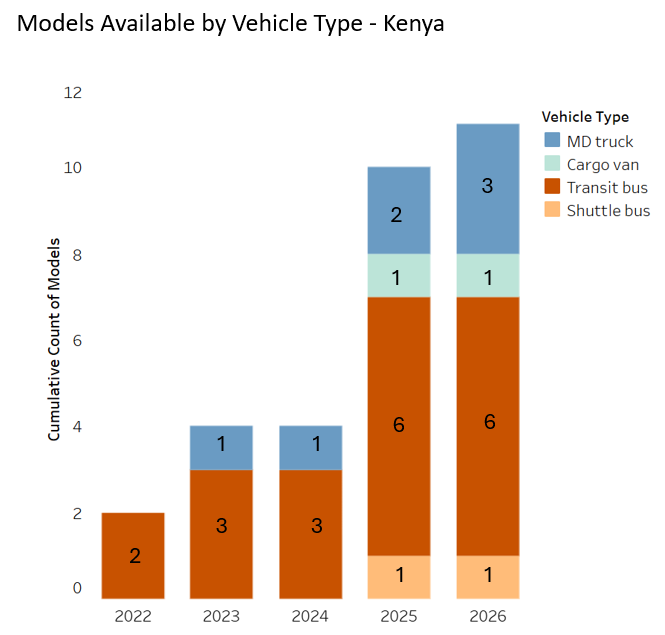
| Vehicle category | 2022 | 2023 | 2024 | 2025 | 2026 | Grand total |
|---|---|---|---|---|---|---|
| MD truck | 0 | 1 | 1 | 2 | 3 | 7 |
| Passenger vehicle | 0 | 0 | 0 | 1 | 2 | 3 |
| Pick-up truck | 0 | 1 | 1 | 5 | 5 | 12 |
| Shuttle bus | 0 | 0 | 0 | 1 | 1 | 2 |
| Transit bus | 2 | 3 | 3 | 6 | 6 | 20 |
| Tricycle | 0 | 0 | 2 | 2 | 2 | 6 |
The strongest growth is in transit buses and pick-up trucks, indicating early commercial viability in public transport and utility fleet applications, two segments central to Kenya’s electrification ambitions. Electrification is no longer hypothetical. Multiple EV platforms are already available to serve:
- Urban and peri-urban bus routes
- Staff and institutional transport
- Last-mile and mid-mile logistics
Operational Performance Already Matches Many Duty Cycles
A key concern for fleet operators is whether EVs can meet real-world operational demands. For many Kenyan use cases, the answer is increasingly yes.
Urban bus routes, staff shuttles, and urban freight typically operate on predictable daily distances. The driving ranges of electric buses and medium-duty trucks entering the market now fall within these duty cycles, particularly when paired with depot-based or corridor charging.
Challenges such as payload optimisation and charging infrastructure for long-haul freight remain, but these are planning and system design issues, not technological impossibilities.
For many fleets, the limiting factor is no longer vehicle range; it is charging planning and financing models.
Economics Are Improving. Policy Can Accelerate Further
Although upfront costs for electric buses and trucks are higher than diesel equivalents, they benefit from:
- Lower energy costs per kilometre
- Reduced maintenance due to fewer moving parts
- Improved energy price stability compared to fuel
As global battery prices decline and local charging infrastructure expands, the total cost of ownership (TCO) is becoming increasingly favourable, particularly for high-utilisation fleets.
Policy measures in Kenya’s framework can further improve the economics through:
- Tax and duty considerations
- Support for local assembly
- Incentives for charging infrastructure investment
Industry Perspective
“Kenya’s National Electric Mobility Policy comes at a pivotal moment, as the market is already beginning to shift rather than waiting for the future. We are witnessing growing private sector interest, an increasing range of electric vehicle options entering the market, and stronger momentum around sustainable mobility. The Policy provides the coordination and direction needed to move from pilots and ambition to real scale and impact. Its implementation is focused on ensuring a just transition that leaves no one behind.”
Racheal Wanyamawi
Principal Road and Rail Transport Officer
State Department for Transport
From Framework to Scale
Kenya now has the foundations needed to accelerate the electrification of medium- and heavy-duty transport. The country has a clear policy direction that formally brings buses and trucks into the national e-mobility transition, a growing pipeline of electric vehicle models entering the market, and an expanding base of private sector experience from pilots and early deployments. These elements together signal that the conversation can move beyond “if” electrification will happen to “how fast” it can scale.
The priority now is to shift from early adoption to large-scale deployment. This means accelerating the rollout of charging infrastructure along key freight and passenger corridors as well as at fleet depots, where most commercial vehicles operate. It also requires targeted financial mechanisms that reduce upfront cost barriers for fleet operators, enabling more companies to transition from single-vehicle pilots to full fleet replacement plans.
Public leadership will be equally important. Aligning government and institutional vehicle procurement with zero-emission targets can create predictable demand, send strong market signals, and lower costs through volume. At the same time, strengthening Kenya’s engagement in global zero-emission vehicle initiatives can unlock technical support, investment, and knowledge exchange, ensuring that the country remains at the forefront of the transition to clean, modern commercial transport.
Electric trucks and buses are no longer “future technology” for Kenya. The vehicles are arriving. The policy is in place. The priority now is coordinated scale-up.